
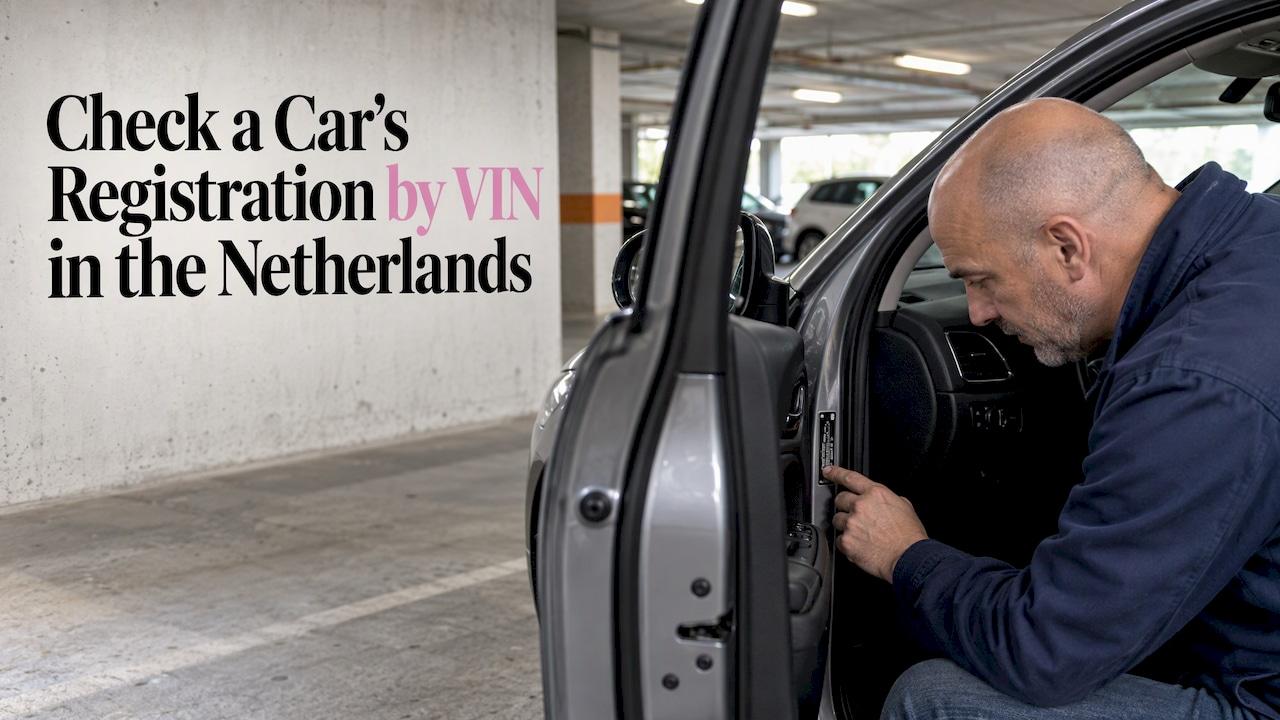
In the Netherlands, the official registration data is organized by licence plate, not by VIN. The practical route is therefore two steps. You find the VIN on the registration card and compare it with the car, then you run the plate through the RDW check or a platform that combines registers. This guide explains what that check shows, how to see where and when a car was first registered, and what to do when the car came from abroad.
TL;DR
- The free RDW kentekencheck shows the number of owners, an odometer judgment, technical and fiscal data and the last transfer date. It never shows owner personal data.
- The VIN is printed in code E on the back of the Dutch registration card. Compare it with the number on the car itself before anything else.
- For an imported car, the date of first ascription in the Netherlands is later than the date of first admission. That gap tells you the car came from abroad.
- A registration check says nothing about technical condition. Add an independent inspection before you pay.
- Our free plate check combines RDW data, APK and stolen status in one view, and Leo accepts a plate or a VIN.
Table of Contents
- What a VIN registration check can and cannot do
- Where to find the VIN and the key dates
- What the free RDW check shows
- Where was the car first registered?
- Checking an imported or foreign car
- Is there a European registration check by VIN?
- When the VIN, documents and lookup do not match
- Our perspective
- A five-step check before you pay
- Run the check with CarTrace
- FAQ
- Sources
What a VIN registration check can and cannot do
People search for a registration check "by VIN" because the VIN is the one number that follows a car for life. A plate can change, a VIN does not. That is why it is the right number to verify against the physical car.
The Dutch public check works differently. The RDW registration number check gives insight into a vehicle's historical data and whether it can be transferred. If "Registration possible?" says no, the vehicle cannot be transferred because it is registered as stolen or exported, according to the RDW buying tips. The same page explains that under Recalls you can see whether RDW knows of any recalls, although a manufacturer is not obliged to report them to RDW.
So the workflow is simple:
- Read the VIN from the registration card and from the car.
- Confirm they match.
- Look up the plate to see what the register holds about that VIN.
- Add an inspection for the things no register records.
The VIN lookups you may see between authorities exist too, but they are not a public tool. We come back to that in the section on European checks.
Where to find the VIN and the key dates
Since 1 January 2014, the Dutch registration certificate consists of a credit-card-sized registration card and a 9-digit registration code. According to RDW, the VIN is a mandatory field (code E) on the back of the card. Next to it you find the date of first authorisation for use on the public road (code B) and the date of first registration in the Netherlands.
When you view a car, do this:
- Ask the seller for the registration card, not a photo of it.
- Find code E and compare the 17 characters with the VIN on the car, usually visible at the base of the windscreen or on the chassis plate.
- Check that the plate on the card is the plate on the car.
- Note the dates in code B and the Dutch first registration date. You will need them in a moment.
If any character differs, stop the purchase and ask for an explanation in writing. A typo on an advert is one thing. A different VIN on the car than on the card is something else.
What the free RDW check shows
The free public check is available online and in the RDW vehicle app. RDW says it shows general information such as the number of owners, an odometer judgment, technical and fiscal data and when the plate was last transferred. Owner personal data is not visible because of privacy legislation.
The ANWB adds that the check shows whether a vehicle is WAM-insured, whether a driving ban (WOK) is registered, whether the car is registered as stolen, APK data, technical data and fiscal information such as catalogue price and BPM amount. Maintenance history is not part of the public check.

The register itself holds more than the public sees. The Kentekenreglement lists the stored data, including registration and ascription data, type approval data, data on vehicles registered abroad for which registration or ascription is requested, and data on missing vehicles and theft or embezzlement reports. Access to the name and address of the plate holder is restricted, which is why the public check stays anonymous.
We wrote a separate walkthrough of what you can and cannot look up for free at RDW, and a guide to reading the Dutch vehicle information system if you want to see how the fields relate.
Where was the car first registered?
This is the question behind many VIN searches, and the answer sits in two different dates.
| Term | Dutch | What it means |
|---|---|---|
| First admission | Datum eerste toelating | The first time the car was allowed on the public road, anywhere |
| First ascription in the Netherlands | Datum eerste tenaamstelling in Nederland | The first time the car was put in someone's name in the Dutch register |
| Last ascription | Datum tenaamstelling | The most recent transfer to a new holder |
The ANWB explains the consequence: for an imported car, the date of first ascription in the Netherlands is later than the date of first admission, which reveals the car was imported. For a car registered in the Netherlands, the public check also shows how many times the car was registered in the past 9 years on the name of a Dutch person, company or institution.
A worked example. A car shows first admission in March 2021 and first Dutch ascription in November 2023. It spent two and a half years somewhere else. That is not a problem by itself, but it is a reason to ask where, who owned it and how the mileage was documented.
Two more points help you read these dates correctly:
- The Dutch Tax Administration notes in its knowledge group publication on BPM refunds that registration in the Dutch register (inschrijving) takes place in principle only once, while a car can be ascribed (tenaamstelling) many times after a change of owner.
- For some imports, the date of first admission is set from documents. Article 3 of the regulation on establishing the date of first admission lists examples such as a non-ascribed German Fahrzeugbrief, a US Certificate of Origin, a manufacturer declaration or an original purchase invoice from the last country of sale. The date on the card therefore rests on paperwork, which is one more reason to ask for the import documents.
Checking an imported or foreign car
An imported car deserves a slower check. The odometer is the main risk, because the mileage history lives in another country's system.
RDW advises buyers of cars from abroad to check whether the odometer reading makes sense using reliable documents such as maintenance invoices or Digital Service Register records. For Belgium, the seller must provide a Car-Pass with mileage information. For a vehicle imported from Belgium on or after 13 January 2025, the mileage is stated in the RDW vehicle report.
The RDW vehicle report is free for the owner or holder via DigiD. It includes:
- make, trade name, fuel and catalogue price
- APK expiry and APK history with repair and advice points
- date of first admission, date of first issue in the Netherlands and date of last ascription
- number of owners, emission class and maximum towable mass
- recall information and vehicle status history, such as scrap or export
- for passenger cars and light commercial vehicles, an odometer verdict, which also applies to cars imported from Belgium on or after 13 January 2025 and from Germany on or after 3 February 2026
As a buyer you cannot pull this report yourself, but you can ask the seller to download it and show it to you. That is a reasonable request for any car.
One practical detail for imports: the ANWB points out that maximum trailer masses are sometimes missing or differ from the correct values. Registering or raising them later typically needs a manufacturer declaration on the VIN and an RDW inspection, which does not always succeed. If you plan to tow, check this figure before you buy.
For stolen status, which matters most with foreign cars, read our guide on how to check whether a used car is stolen.
Is there a European registration check by VIN?
Between authorities, yes. EUCARIS is the system vehicle-registration authorities use to exchange information. According to EUCARIS, a vehicle can be identified by licence plate, registration document number or VIN, and a Multi Country Inquiry can search by VIN in all connected member states.
This is the reason a foreign car can be checked at the moment of Dutch registration: the authority can look up the VIN abroad. It is a tool for registration applications, not a public search box for consumers.
As a buyer you get to the same kind of insight another way. You combine the VIN from the card, the Dutch register data by plate, and the documents from the country of origin. A platform that brings national and European sources into one place saves you the manual steps, which is what we built CarTrace to do.
When the VIN, documents and lookup do not match
Mismatches happen. A few situations and what to do:
- The card might not belong to the car or the code. RDW lets you check for free whether a registration card and registration code are valid and belong together, using the registration number and document number. If the card is invalid, the vehicle cannot be transferred or suspended. If the card is valid but not linked to the code, a new registration code has to be requested.
- The register says "registration possible: no". The RDW tips page links this to a stolen or exported status. Do not hand over money. Walk away or ask the seller to resolve it first.
- The first admission date seems too early or too late. Ask for the import documents behind it.
- The mileage in the advert is lower than the odometer verdict suggests. Ask for maintenance invoices.
If you suspect the car is stolen, you can report it through our stolen car service, listed on the pricing page.
Our perspective
Most buyers start with a VIN search because it feels like the most precise number. In practice, the Dutch registers answer to the plate, and the real value comes from putting the sources next to each other: register data, APK results, stolen status, recalls, and for imports the history from before the car arrived.
That is why we built CarTrace as one platform. Our aim is to give you more granular and up-to-date information, free at the first step, than a single paid report usually gives, and to let our AI agent Leo point out the warnings that matter for your situation instead of leaving you with a wall of fields.
We also want you to buy calmly. A clear warning before you pay is cheaper than a surprise afterwards, and a clean check lets you negotiate with confidence.
Mo
A five-step check before you pay
- Compare the VIN. Card code E against the car. Same plate, same VIN.
- Validate the card. Use the RDW card check with the registration number and document number.
- Read the dates. Admission versus first Dutch ascription, and the number of owners.
- Check status and mileage. Stolen, exported, recalls, APK history and the odometer judgment. For imports, ask for the country-of-origin documents.
- Inspect the car. A register tells you the facts on file, not the condition. The ANWB recommends an independent purchase inspection (aankoopkeuring) for more certainty. Our guide on checking engine, brakes, battery and tyres shows what to look at, and the full used-car checklist runs from the advert to the registration. Buying electric? See 12 things to check on a used EV.
If the car will be driven in city centers, also see whether it can still enter low-emission zones in the Netherlands.
Run the check with CarTrace
Start with a plate on our free licence plate check. You get RDW data, APK and stolen status without paying. If you want the complete report, ongoing monitoring or Leo's guidance, the plans are:
| Plan | Per month | Per year |
|---|---|---|
| Gratis | No published price | No published price |
| Basic | €4.15 | €49.90 |
| Advanced | €8.32 | €99.90 |
| Expert | €16.65 | €199.90 |
The complete car report is currently free during our launch period. See the current plans and what each includes for the latest status.

You can also ask Leo, our AI car advisor, about any plate or VIN, and read why CarTrace brings one plate and the whole story together.
FAQ
Can I check a Dutch car's registration with only the VIN?
The public Dutch check runs on the licence plate. The VIN is still essential: you read it from code E on the registration card and compare it with the car. Between authorities, EUCARIS can search by VIN across connected countries, but that is not open to the public.
How do I see where my car was first registered?
Look at the date of first admission and the date of first ascription in the Netherlands in the RDW check or vehicle report. If the Dutch date is later than the admission date, the car was imported. The country itself is not shown in the public check, so ask the seller for the original documents.
Does a registration check show the owner's name?
No. The free RDW check does not show personal data of owners because of privacy legislation. It does show the number of owners and the date of the last transfer, which is what a buyer needs to judge the history.
What should I check on a car imported from Belgium or Germany?
For Belgium, ask for the Car-Pass. RDW's odometer verdict also covers cars imported from Belgium on or after 13 January 2025 and from Germany on or after 3 February 2026. Back it up with maintenance invoices and compare the admission and first Dutch ascription dates.
Does a clean registration check mean the car is in good condition?
No. The ANWB states that a plate check tells you a lot about registration and facts but nothing about the current technical condition. Combine it with an independent purchase inspection before you buy.
Sources
- RDW kentekencheck
- RDW: tips for buying a vehicle
- RDW: about the registration certificate
- RDW vehicle report
- RDW: check the registration card
- ANWB: what is the use of a kentekencheck
- Kentekenreglement (wetten.nl)
- Regeling vaststelling datum eerste toelating, article 3
- Belastingdienst: KG:013:2022:7
- EUCARIS: AVI and VHInfo