
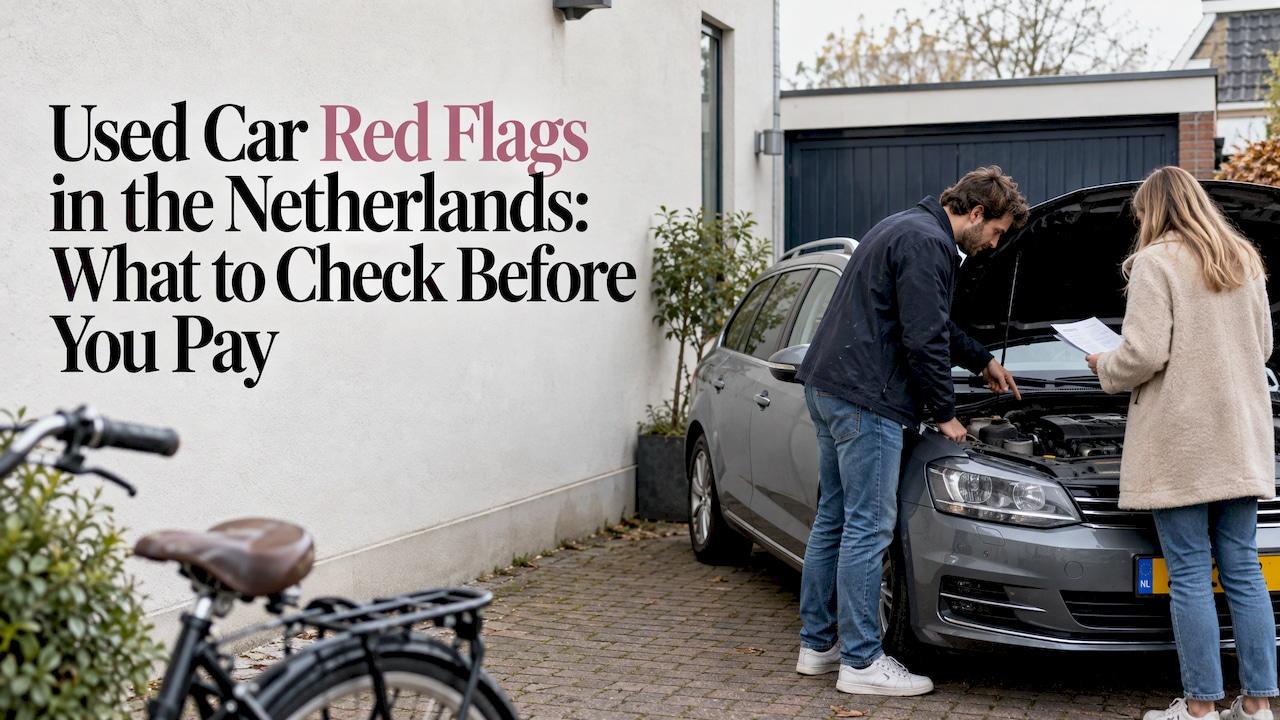
The most expensive red flags on a used car are the ones you can look up before you visit: an illogical odometer reading, a car that cannot be transferred, an unclear import history or an open recall. Check the plate first, then the car, then the seller. With a free licence plate check from CarTrace you can screen an advert in a minute, before you spend a Saturday on a test drive.
TL;DR
- Start with data: the odometer record, transfer status, APK (the Dutch periodic inspection) and recalls tell you more than the advert does.
- An RDW odometer verdict of "Onlogisch" (illogical) is a reason to stop or to renegotiate in writing.
- Imported cars deserve extra scrutiny, because RDW estimates that 30% to 50% of imports have an illogical reading.
- Reluctance to allow an independent inspection, cash-only deals and missing service records are seller red flags.
- Put every promise (damage-free, mileage correct) in the purchase contract.
Table of Contents
- Red flags in the data you can check from home
- How the CarTrace plate check helps you screen
- Red flags on the car itself
- Red flags in the seller and the paperwork
- Protect yourself before you pay
- What the law gives you if something turns out wrong
- Sellers, leasing companies and dealers
- FAQ
- Sources
Red flags in the data you can check from home
An illogical odometer reading
Rolling back the odometer has been prohibited since 2014 but still occurs, and a tampered reading makes the car more expensive to buy and maintain than you think. RDW's own report says that of 9.5 million registered vehicles, about 163,000 (1.8%) have an illogical reading, and that for imported vehicles the estimate is 30% to 50%. Stichting VbV, a foundation that fights odometer fraud, reports more than 240,000 passenger cars with an illogical reading in 2026.
What to do: look at the odometer verdict (the "telleroordeel") and the history of readings. A single "Onlogisch" is not a detail. Walk away, or agree a lower price and have it written down.

A car that cannot be transferred
The RDW plate check shows whether the car can be registered in your name. A "nee" under "Tenaamstelling mogelijk?" means it cannot be transferred, for example when it is registered as stolen or exported. If you see that, do not pay a deposit. Our guide on how to check if a car is stolen explains what to look for.
APK, driving bans and insurance
A plate check also shows whether the car has a valid APK and until when, whether a WOK status (a driving ban until the car is repaired and re-inspected) is registered, and whether the car is insured under the WAM, the Dutch compulsory liability insurance, according to ANWB. A WOK entry or an APK that expired long ago points to a car that was neglected or damaged.
Recalls
RDW shows whether a recall is known for the vehicle, but the manufacturer is not obliged to inform RDW. An open recall in the data is a question for the seller: has it been carried out, and is there proof?
Imports, clones and rebadged cars
Imported cars carry the odometer risk above, and foreign readings are harder to follow. RDW also warns about two identity frauds: rebadging, where the identity of a car damaged beyond repair is reused, and cloning, where the details of a car in use are copied. With a clone the papers and plates are forged, so a registration check alone does not expose it. Compare the VIN on the car with the VIN on the papers and in the data.

How the CarTrace plate check helps you screen
CarTrace combines RDW data, inspection data and theft registers in one place, so you see odometer, APK, theft status and recall information together. The basic plate check is free. The paid plans are Basic (4,15 € per month or 49,90 € per year), Advanced (8,32 € per month or 99,90 € per year) and Expert (16,65 € per month or 199,90 € per year), and the complete car report is free until 1 January 2027. Our AI agent Leo answers questions about any plate or VIN. For what RDW data does and does not show, read our RDW licence plate check guide and the OVI explainer.

Run the plate from the advert through the free plate check before you contact the seller. If you want ongoing alerts or a full report, compare the plans.
Red flags on the car itself
Data cannot tell you everything. ANWB advises looking at whether the car looks logical: doors and bonnet that close neatly, even gaps and no color differences in the paint. Add these checks:
- Wear that does not match the mileage. A shiny steering wheel, worn pedals and a sagging driver's seat on a car with low mileage is a classic sign of a rolled-back odometer.
- Uneven panel gaps or mismatched paint. These suggest repairs after an accident.
- Warning lights, strange noises or smells. Treat them as a reason to stop the test drive and ask questions.
- Mismatched number plates or VIN. Check that plates, papers and the car agree.
For a step-by-step walk-through, see how to check a used car and our guide to engine, brakes, battery and tyres. If you are looking at an EV, use the electric car checklist.
Red flags in the seller and the paperwork
- Reluctance to allow an independent inspection. A seller confident in the car has no reason to refuse. Stichting VbV and ANWB both recommend an independent purchase inspection when in doubt. Our guide to the pre-purchase inspection covers cost and what to do with the report.
- Incomplete or illogical maintenance history. Maintenance history is not part of the public plate check, so ask for invoices and service records.
- A price far below comparable cars. Compare against similar models on our car models pages.
- Pressure to pay cash or quickly. RDW advises private buyers to verify the seller's identity, the VIN and the registration documents, check keys and service records, transfer the car at a registration counter and pay by bank rather than cash.
- A meeting place that is not the seller's home. For private sales RDW advises meeting at the seller's address, so you can see where the seller lives and match the name to the papers.
Protect yourself before you pay
- Screen the plate. Check odometer, transfer status, APK, recalls and theft status.
- Ask for documents. Registration papers, service invoices and previous APK reports.
- Inspect and drive. Bring someone who knows cars. The Consumentenbond notes an "onderzoeksplicht" (duty to investigate) for older or high-mileage cars: you should ask thorough questions and check the car well.
- Get an independent inspection if you have doubts.
- Write promises into the contract. ANWB stresses that a history check is a tool, not a guarantee, and that promises such as damage-free or mileage guaranteed belong in the purchase contract.
- Pay by bank and transfer at the counter.
What the law gives you if something turns out wrong
Your rights depend on who sells. Against a business, the car must match what was promised. A kantonrechter ruling in 2026 held that a disclaimer of warranty does not prevent a successful non-conformity claim when a defect makes a car unsafe and the buyer could not easily discover it.
Key points for consumers:
- If a defect shows within 12 months, it is presumed to have existed at delivery and the seller must prove otherwise. After 12 months you must prove both the defect and that it was already present.
- A rolled-back mileage is always a fault, and you can hold the seller accountable.
- If a seller knew about a defect and gave wrong or incomplete information, there may be "dwaling" (mistake), and you can seek to annul the contract, but you must prove the information was wrong.
- In one case, De Geschillencommissie annulled a purchase because the car did not match the advertised ST-Line version. The buyer received 6.000 € back with a 1.500 € deduction for about 12,000 km of use.
If you face a dispute, contact a lawyer or your legal expense insurer. Good evidence starts with what you saved before buying: the advert, the plate check and the contract.
Sellers, leasing companies and dealers
The same data protects the other side of the deal. A seller who shows a clean odometer record and APK status up front answers most buyer doubts. A dealer or lessor handling many vehicles benefits from checking transfer status, theft status and odometer verdicts before taking a car in, because a car that cannot be transferred cannot be resold. CarTrace also offers ongoing monitoring for owners and data partnerships for dealers, marketplaces and insurers.
Our view
We built CarTrace because the facts that decide a used car purchase already exist in registers, but they are spread across places most buyers never visit. Odometer verdicts, inspection data and theft registers belong on one screen, before you drive across the country.
A red flag is information, not a verdict. Our approach is to give you the warning early and in plain words, so you can negotiate, ask for proof or walk away calmly. Leo, our AI agent, turns the data into practical next steps for the car you are looking at.
Mo
FAQ
What does a red flag mean on a used car?
It is a warning sign that the car's condition, history or seller needs closer scrutiny. Examples are an illogical odometer reading, a car that cannot be transferred, or a seller who refuses an independent inspection.
Which red flag should make me walk away immediately?
A "nee" under "Tenaamstelling mogelijk?" means the car cannot be transferred, so stop there. An "Onlogisch" odometer verdict is nearly as serious: walk away or renegotiate in writing.
Is a clean history check enough?
No. ANWB notes that no record does not prove there was never damage. Combine the plate check with a look at the car, the service invoices and, when in doubt, an independent inspection.
How do I protect myself when buying from a private seller?
Meet at the seller's home, verify identity, VIN and papers, transfer at a registration counter and pay by bank. Write promises into the contract.
Sources
- Voorkom tellerfraude, Stichting VbV
- Tips als u een tweedehands auto gaat kopen, RDW
- Tips for buying a vehicle, RDW
- Tellerrapport in strijd tegen terugdraaien tellerstanden, RDW
- Wat is het nut van een kentekencheck?, ANWB
- Zo check je het schadeverleden van een auto, ANWB
- Wettelijke garantie: je rechten na aankoop, ANWB
- Tweedehands spullen: wat zijn mijn rechten?, Consumentenbond
- ECLI:NL:RBMNE:2026:4773, Rechtspraak
- Ontbinden koopovereenkomst, DAS
- Koop ontbonden wegens afwijkende uitvoering, De Geschillencommissie